

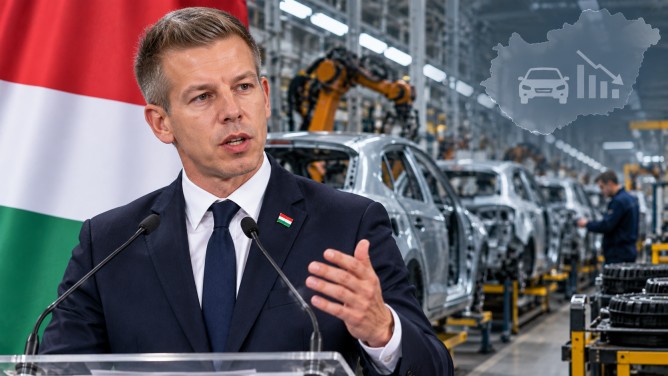
In recent years, Hungary has established itself as a key player in Europe’s automotive industry, drawing substantial investments from major car manufacturers worldwide. However, this thriving sector might encounter significant shifts as Prime Minister Péter Magyar’s government considers implementing more stringent environmental regulations, scaling back corporate incentives, and increasing wages. This potential policy change signals a new direction for Hungary’s automotive landscape, which has long attracted major players like BMW, Mercedes-Benz, and Volkswagen.
Several global automotive giants have significantly bolstered their presence in Hungary. BMW has committed nearly €2 billion to its plant in Debrecen, which boasts an annual production capacity of 150,000 vehicles. Meanwhile, Mercedes-Benz is expanding its operations in Kecskemét, and Volkswagen continues to maintain a strong foothold with extensive engine and vehicle production in Győr. The nation’s appeal extends beyond traditional car manufacturing, as Hungary has become a magnet for investments in electric mobility and battery production, with companies like BYD, CATL, and EVE Energy establishing facilities to capitalize on the growing electric vehicle market.
Hungary’s automotive sector has thrived partly due to its competitive 9% corporate tax rate and relatively low labor costs, which in 2025 averaged around €15.20 per hour compared to approximately €45 in Germany. Projections indicate that the country could see an annual production of about 541,000 vehicles by 2028. However, the new administration’s tougher stance on environmental compliance poses challenges, particularly for battery manufacturers. CATL, for instance, is facing regulatory scrutiny for wastewater disposal practices, and Semcorp’s operations have been temporarily halted over environmental and fire-safety concerns.
Prime Minister Magyar’s proposal to elevate the minimum wage to 1 million forints by 2030 further complicates the scenario, potentially driving up production costs. Industry experts caution that a confluence of higher wages, stricter environmental standards, and reduced incentives might undermine the competitiveness of Hungary’s burgeoning battery and electric vehicle production sector. This could also have ramifications for Austria, which supplied €925 million worth of automotive components to Hungarian factories in 2024, including electric motors and steel parts.
Despite these challenges, industry stakeholders acknowledge Hungary’s critical role in manufacturing, technology transfer, autonomous vehicle development, and research collaborations. However, they stress that the future trajectory of Hungary’s automotive industry will largely hinge on the policy decisions made by Magyar’s administration, which will determine the nation’s capacity to maintain its competitive edge in an evolving global market.