

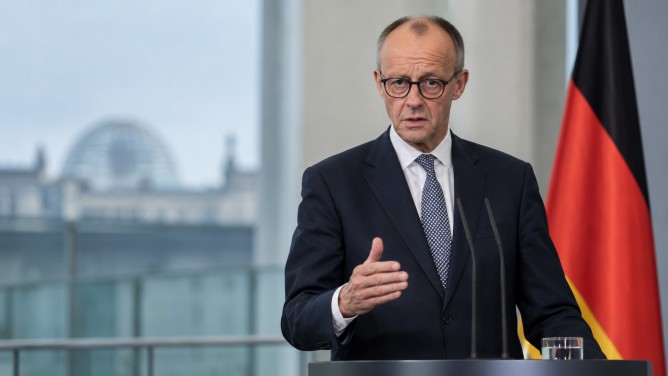
Germany’s political landscape is witnessing significant shifts as regional elections reveal deepening divides across the nation. In recent elections held in Berlin and Mecklenburg-Western Pomerania, Chancellor Friedrich Merz’s Christian Democratic Union (CDU) suffered notable setbacks, while the far-right Alternative for Germany (AfD) made substantial gains.
In Berlin, the left-leaning party Die Linke captured the largest share of the vote, securing approximately 25.7%, positioning itself ahead of the CDU, which garnered 18.8%. The AfD, further solidifying its presence, claimed third place with about 16.3% of the vote. This outcome marks a significant shift in the capital’s political dynamics, highlighting the challenges facing the CDU in urban regions.
The political upheaval was even more pronounced in Mecklenburg-Western Pomerania, where the AfD emerged as the leading party, securing roughly 38.2% of the vote. The Social Democrats trailed closely with 35.5%, while the CDU’s performance plummeted to a mere 4.9%, falling below the threshold necessary for representation in the state parliament. This result underscores the AfD’s growing influence, particularly in the eastern parts of Germany.
The recent electoral outcomes intensify the scrutiny on Chancellor Merz, who is already under pressure following the AfD’s prior electoral success in Saxony-Anhalt. Despite these setbacks, Merz remains committed to his leadership role, emphasizing his intention to continue with the government’s economic and social reform agenda.
These developments are expected to spur internal debates within the CDU regarding its leadership and strategic direction. The elections not only reflect the AfD’s strengthening foothold in certain regions but also showcase the increasing fragmentation of Germany’s political landscape, with distinct regional variations in voter preferences.